1
1. Image
Riverside City Court is in session. Look at the people, evidence, and tension in the room.
Teacher note: Riverside City Court is in session. Look at the people, evidence, and tension in the room.
Lesson preview
Step into a courtroom drama where you examine witness statements, compare evidence, and decide whether Maya Patel copied a rival bakery’s secret recipe or created a similar roll by accident. You’ll build persuasive arguments, use cautious language like must, might, and could, and present a final verdict based on the most convincing evidence.
You can preview the first 2 activities. Sign up to unlock the full lesson and add it to your library.
Riverside City Court is in session. Look at the people, evidence, and tension in the room.
Teacher note: Riverside City Court is in session. Look at the people, evidence, and tension in the room.
Teacher note: Courtroom and opinion language for the Sunrise Swirl trial.
We use must have, might have, and could have to talk about past actions when we are making a deduction or considering possibilities.
We often combine these forms with opinion phrases such as:
Subject + must have + past participle
Subject + might have + past participle
Subject + could have + past participle
Use must have when the evidence feels strong. Use might have when you want to stay cautious. Use could have when you want to offer an alternative explanation. Use because to explain your reasoning clearly.
Teacher note: Modal deduction and cautious judgment in a trial context.
Sign up free to unlock “3. Grammar” and the rest of this lesson
Create free teacher accountListen to the witness statements about the Sunrise Swirl dispute. Then answer the questions about who said what, what details match, and where the timeline becomes unclear.
Judge: The court will now hear two brief statements about the Sunrise Swirl case.
Nora: I supply flour and spices to Riverside Bakery every Monday morning. On the day before the café launch, I saw Maya Patel asking about the cinnamon ratio and the glaze finish. She wrote notes on a tablet and seemed cautious, not secretive.
Ethan: I visited the café on Friday afternoon. The roll in the display case had a shiny top and a neat spiral, but the crumb was lighter than the bakery’s version. I also remember the icing tasting less sweet, so I was not sure it was a direct copy.
Judge: Thank you. The jury should compare the details carefully and notice any differences in timing, tone, and product design.
Teacher note: Listen to two witness statements and identify the details that do not fully match.
Sign up free to unlock “4. Listening” and the rest of this lesson
Create free teacher accountChoose the best answer for each question.
Which detail was mentioned in the contract email about the bakery consultation?
What detail from the photo made the comparison less straightforward?
Which witness said Maya was taking notes on a tablet?
Why did the jury still need to think carefully before deciding?
Teacher note: Check the key facts from the trial evidence.
Answer key (teachers only)
Students do not see this. Add or update questions and answers below the activity.
Sign up free to unlock “5. Multiple choice” and the rest of this lesson
Create free teacher accountMark each statement True or False.
Maya Patel manages a small café.
The rival bakery is accused of copying Maya’s recipe.
The class must examine contradictions in the evidence.
The final verdict should be based on one piece of evidence only.
Teacher note: Decide whether each courtroom statement is true or false.
Answer key (teachers only)
Students do not see this. Add or update questions and answers below the activity.
Sign up free to unlock “6. True / false” and the rest of this lesson
Create free teacher accountCompare the two cinnamon rolls carefully. What looks similar, and what looks different?
Teacher note: Compare the two cinnamon rolls carefully. What looks similar, and what looks different?
Sign up free to unlock “7. Image” and the rest of this lesson
Create free teacher accountChoose the best caption for each image.
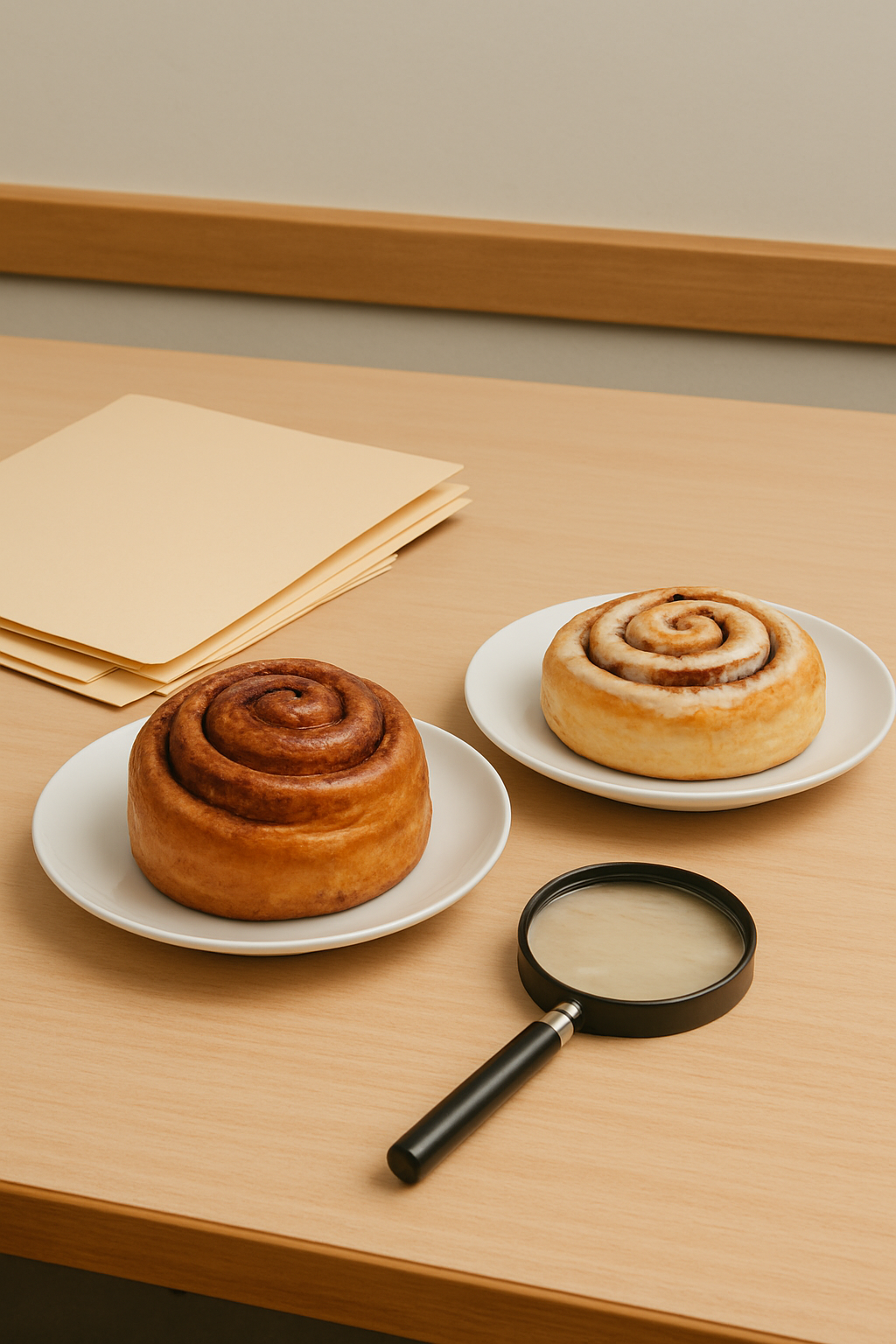
Teacher note: Pick the most accurate caption for each courtroom evidence image.
Sign up free to unlock “8. Pick the caption” and the rest of this lesson
Create free teacher accountUse the evidence from the case to argue your side. Keep your tone serious, clear, and respectful. You should not try to “win” by speaking loudly; you should sound convincing by giving reasons and using cautious language.
After both students speak, agree on one sentence that starts with:
Then add one sentence that begins with:
Teacher note: Role-play prosecution and defense using cautious courtroom language.
Sign up free to unlock “9. Speaking” and the rest of this lesson
Create free teacher accountChoose one side: prosecution or defense.
Write a short note for the jury that includes:
Keep your tone formal, persuasive, and focused on the case. Write enough detail to support an oral presentation later.
Aim for at least 70 words.
Teacher note: Write concise prosecution or defense notes for the jury.
Sign up free to unlock “10. Writing task” and the rest of this lesson
Create free teacher accountMatch each phrase with its meaning.
Column A
Column B
Teacher note: Match courtroom and opinion language to clear meanings.
Answer key (teachers only)
Students do not see this. Add or update questions and answers below the activity.
Sign up free to unlock “11. Matching” and the rest of this lesson
Create free teacher accountChoose the best answer for each sentence.
The email mentions a private meeting, so Maya ______ known the recipe discussion was confidential.
The icing looks different, so the café roll ______ been copied exactly.
Which sentence sounds most cautious?
The customer review praises the lighter texture, so the new roll ______ a different baking method.
Choose the best reasoned deduction: The spiral and glaze are close, so the two products ______ come from a shared inspiration.
Which sentence is grammatically correct?
Teacher note: Choose the best modal form to express deduction and cautious opinion.
Answer key (teachers only)
Students do not see this. Add or update questions and answers below the activity.
Sign up free to unlock “12. Grammar practice” and the rest of this lesson
Create free teacher accountWho is responsible for what
Stay in your role during the live voice chat. The AI partner follows the other role.
You (student)
Jury member questioning a witness
AI partner
Witness from the rival bakery
Students connect here for a live 5-minute AI voice conversation.
Teacher note: Courtroom role-play: the student questions a witness in the Sunrise Swirl trial using evidence and cautious deduction language.
Sign up free to unlock “13. AI conversation” and the rest of this lesson
Create free teacher accountAnswer both questions in a few clear sentences.
Which piece of evidence was most convincing, and why?
What is your verdict: stolen recipe or accidental similarity? Explain in one or two sentences.
Teacher note: Write the jury’s final reasoning in a concise response.
Sign up free to unlock “14. Short answer” and the rest of this lesson
Create free teacher accountYou are now the jury. Work in pairs or small groups to agree on a final decision, then share it with the class in a clear, formal way.
Use this model if you want:
After the verdict, answer this together:
Teacher note: Final class speaking stage: students deliver a jury verdict, justify the decision with evidence, and reflect on how persuasion affected their views.
Sign up free to unlock “15. Speaking” and the rest of this lesson
Create free teacher account13 more activities in this lesson
Create a free teacher account to view the full lesson, copy it to your library, and assign it to students.
Sign up freePreviewing the first 2 activities