1
1. Image
NASA’s Psyche mission captured striking views of Mars on its way to a metal-rich asteroid.
Teacher note: Show the ScienceAlert article image and headline.
Lesson preview
Explore how NASA’s Psyche spacecraft used Mars for a close flyby, a speed boost, and a test of its instruments on the way to a mysterious metal-rich asteroid. You’ll discuss space exploration, learn key news vocabulary, and practice describing the mission in clearer English.
You can preview the first 2 activities. Sign up to unlock the full lesson and add it to your library.
NASA’s Psyche mission captured striking views of Mars on its way to a metal-rich asteroid.
Teacher note: Show the ScienceAlert article image and headline.
A NASA spacecraft called Psyche has made a close pass by Mars during its long trip through space. The flyby was not only dramatic to look at; it was also useful for the mission team. As the probe swept past the planet, Mars’ gravity helped change its path and give it extra speed.
The spacecraft is now heading toward 16 Psyche, a large asteroid in the asteroid belt between Mars and Jupiter. Scientists think this object may contain a lot of metal, which makes it very different from the rocky worlds we usually study. If that idea is correct, the mission could help researchers understand how planets formed in the early Solar System.
During the Mars encounter, the spacecraft also collected new images and measurements. Its instruments were checked and adjusted, and the team used the opportunity to confirm that the mission is still on track for its future arrival at the asteroid.
Context: In science news, reporters often describe space missions with active, exciting language, but the real work is careful navigation, testing, and data collection. A flyby can serve both as a scientific moment and as a practical step in a much longer journey.
Read the original article: https://www.sciencealert.com/nasa-reveals-psychedelic-visuals-of-mars-captured-by-psyche-mission
Teacher note: A short paraphrased news reading that explains Psyche’s Mars flyby, the gravity assist, and the mission’s route toward the metal asteroid. Includes brief context and discussion questions for B2 adults.
Teacher note: Vocabulary set for the Psyche mission lesson, focusing on spacecraft movement, instruments, and mission science. Definitions are polished for adult B2 learners and keep the article’s space-news theme.
Sign up free to unlock “3. Vocabulary” and the rest of this lesson
Create free teacher accountYou will hear a short news summary about NASA’s Psyche mission. Listen for two things: why the spacecraft passed Mars and what it is heading toward next.
Presenter: NASA’s Psyche spacecraft has made an important pass by Mars on its long trip through space. The close approach was not just for the view. It also helped the mission team adjust the spacecraft’s path and gain extra speed. Scientists call this kind of boost a gravity assist.

Presenter: During the flyby, the probe collected new images and data from Mars while moving past the planet at very high speed. The team also used the opportunity to check how well the onboard sensors were working. That kind of testing is useful before a mission reaches its final destination.

Presenter: Psyche is now continuing toward an asteroid in the asteroid belt. What makes this target especially interesting is that it may be rich in metal rather than mostly rock or ice. Researchers hope the mission will reveal more about how objects like this formed in the early Solar System.

Presenter: If the flight plan stays on track, the spacecraft should arrive at the asteroid in 2029. For now, the Mars flyby has given the mission both scientific results and a helpful push on the way forward.
Teacher note: Listening task with a calm B2 news-style monologue about Psyche’s Mars flyby, its gravity assist, and the mission’s goal. Includes comprehension questions focused on the two main purposes of the flyby and the spacecraft’s destination.
Sign up free to unlock “4. Listening” and the rest of this lesson
Create free teacher accountScience news often focuses on what happened and what was discovered, not on who did the action. That is why reporters often use the passive voice.
was / were + past participle
The passive is common when:
Active: NASA engineers tested the sensors.
Passive: The sensors were tested.
Active: The spacecraft used Mars for a speed boost.
Passive: Mars was used for a speed boost.
Incorrect: *The images were take. Correct: *The images were taken.
Incorrect: *The flyby was complete. Correct: *The flyby was completed.
Incorrect: *The data collected during the pass. Correct: *The data was collected during the pass.
Incorrect: *The instruments was tested. Correct: *The instruments were tested.
Too wordy: *The images were captured by the spacecraft by NASA. Better: *The images were captured by the spacecraft.
Change these active sentences into passive ones:
In news reports, the passive voice helps writers sound factual and focused on events. It is especially useful when describing missions, discoveries, and results.
Teacher note: Grammar focus on how science news uses passive voice to report actions, results, and discoveries. Includes clear rules, examples from the mission topic, and common mistakes for B2 adults.
Sign up free to unlock “5. Grammar” and the rest of this lesson
Create free teacher accountLook at the mission idea
a spacecraft passes Mars, uses its gravity, and continues toward a metal-rich asteroid. In pairs, say one thing that surprises you about this mission.
Take turns speaking for 30–45 seconds each. Try to give a reason, not just a short answer.
In groups of three, agree on the best reason to continue this mission. Choose only one:
Then give a 1-minute group report using at least two of these words: gravity assist, sensor, composition, asteroid.
If you could ask the mission team one question, what would it be?
Teacher note: Guided speaking lesson on why scientists use flybys and what makes this Mars-to-asteroid mission worth discussing. Students practice giving opinions, using mission vocabulary, and comparing scientific value with cost.
Sign up free to unlock “6. Speaking” and the rest of this lesson
Create free teacher accountAsk students to write a short paragraph about whether they think missions like Psyche are worth the time and money. They should mention one fact from the article and give their opinion. Encourage use of at least three vocabulary items from the lesson.
Aim for at least 80 words.
Teacher note: Writing task asking students to give an opinion on the value of the Psyche mission, using lesson vocabulary and one passive form.
Sign up free to unlock “7. Writing task” and the rest of this lesson
Create free teacher accountMatch each phrase to the correct picture.
Words & phrases
Tap a word, then tap the matching picture. Each matched pair gets its own color.
Teacher note: Students match four mission-related phrases to AI-generated images, reinforcing key space-news vocabulary through visual recognition.
Sign up free to unlock “8. Match text to image” and the rest of this lesson
Create free teacher accountRecord a voice message of 60–90 seconds.
In your message:
Speak as if you are explaining the news to a friend who has not read the article.
Tap to record
Up to 90 seconds
Teacher note: Voice-message task for B2 adults: students give a short spoken summary of the Mars flyby article and then explain which mission detail interests them most.
Sign up free to unlock “9. Voice message” and the rest of this lesson
Create free teacher accountChoose the best caption for each image.
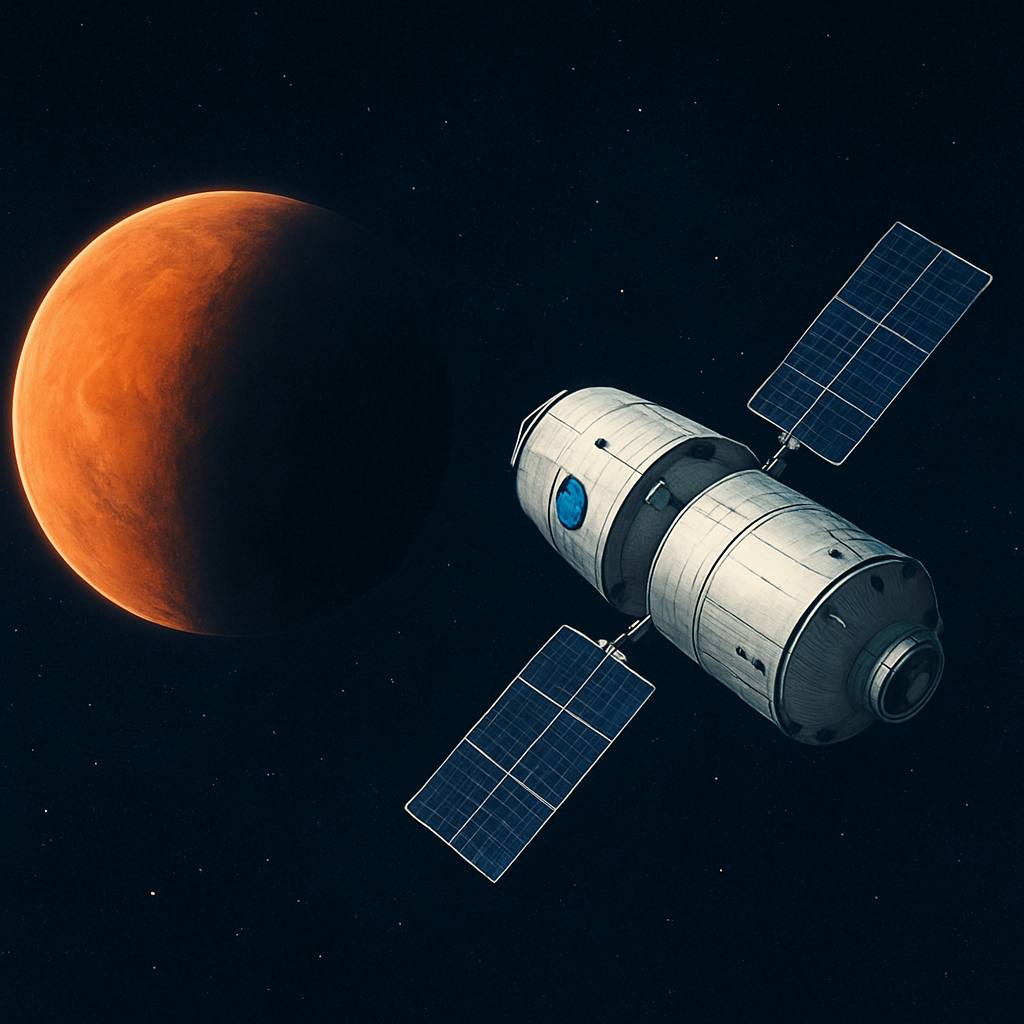
Teacher note: Caption-matching task using three distinct mission images: Mars crescent, gravity-assist path, and instrument data close-up.
Sign up free to unlock “10. Pick the caption” and the rest of this lesson
Create free teacher accountA simple diagram shows Psyche’s route past Mars and on to the asteroid Psyche.
Teacher note: A simple diagram shows Psyche’s route past Mars and on to the asteroid Psyche.
Sign up free to unlock “11. Image” and the rest of this lesson
Create free teacher accountTap the picture that does not belong.
Tap the picture that does not belong with the others.
Teacher note: Odd-one-out image task using four space mission scenes: three show parts of Psyche’s Mars flyby and journey, one shows a different object. Students choose the image that does not belong.
Sign up free to unlock “12. Odd one out (images)” and the rest of this lesson
Create free teacher accountMatch each word or phrase with the correct meaning.
Column A
Column B
Teacher note: Six reusable science-news vocabulary matches based on Psyche’s Mars flyby and asteroid mission.
Answer key (teachers only)
Students do not see this. Add or update questions and answers below the activity.
Sign up free to unlock “13. Matching” and the rest of this lesson
Create free teacher accountAsk students to rewrite a short news-style paragraph about Psyche in simpler English. They should keep the meaning, use their own words, and include one passive sentence.
Aim for at least 60 words.
Teacher note: Writing task: students rewrite a short news-style paragraph about Psyche in simpler English and include one passive sentence.
Sign up free to unlock “14. Writing task” and the rest of this lesson
Create free teacher account12 more activities in this lesson
Create a free teacher account to view the full lesson, copy it to your library, and assign it to students.
Sign up freePreviewing the first 2 activities