2026-07-07 · 24 min read
20 AI Speaking Activities for ESL Teachers (That Your Students Will Actually Enjoy)
Twenty ready-to-use AI speaking activities for ESL and EFL classrooms—with full lesson prompts for Lesso’s AI conversation block and Lesso Talk speaking rooms. Role-plays, debates, mysteries, and real-life scenarios students actually want to talk through.
Why AI speaking beats another worksheet
Speaking is the skill students want most and the one teachers have the least time to scale. In a class of twelve, each learner might get three minutes of real conversation while the rest wait. Homework speaking is worse—record yourself talking to your phone with no partner, no reaction, no reason to keep going.
AI speaking partners change that equation without replacing you. The AI stays in character, responds at the student’s level, asks follow-up questions, and never looks bored when someone searches for a word. You are still the teacher: you choose the scenario, set the language goal, preview the block, and debrief afterward. The AI handles the repetitive one-to-one practice your timetable cannot.
The activities below are designed for two Lesso surfaces teachers already use. Inside a published lesson, add an AI conversation block (Pro) and paste a custom prompt—students speak from the same lesson link you share for reading and quizzes. For open practice, assign a Lesso Talk speaking room or have students join a custom scenario you create on Plus or Pro. Both paths bill speaking minutes on student Talk plans; teacher-assigned rooms can run without a student subscription when you share a Teacher Talk room.
Every activity includes a copy-ready prompt example. Swap the level, topic, or roles to match your class. The goal is not perfect AI theater—it is structured oral practice that feels like a reason to speak, not a grammar drill wearing a dialogue mask.
How to run these in Lesso (two-minute setup)
For a lesson-integrated activity, open your lesson in the teacher workspace, add a student task block called AI conversation, and open block settings. Set conversation style to role-play when the activity has clear roles (customer and clerk, interviewer and candidate). Use topic-based when the student is themselves discussing an issue (debate, opinion, explanation). Set role mode to auto unless you want to name both parts explicitly.
Paste the prompt from this article into custom prompt (or generation prompt if you are generating the block with AI). Add your level and language focus in one line at the top—e.g. “B1 adults, past simple for complaints, polite requests.” Cap sessions if you have a large group so credits stay predictable, and place the block after vocabulary or listening so students have language to spend.
For Lesso Talk, create a custom room (Plus+) or pick a catalog room and adapt it. Describe the scene, your student’s role, the AI partner’s role, level, and tone. Students join from Lesso Talk, allow the microphone, and speak for five to fifteen minutes. Afterward they get a transcript and summary; Plus and Pro add fluency feedback and vocabulary extraction.
In live class, you can monitor which block students are on while they speak with headphones. In homework, publish the lesson link or room URL and ask students to complete one scenario before the next lesson. Debrief with two questions: What phrase did the AI use that you want to steal? Where did you get stuck?
Activities 1–5: Everyday life (students know these scenes)
1. Wrong order at a café — The student is a customer; the AI is a busy barista who got the drink wrong. Goal: politely explain the mistake, ask for a replacement, and thank them. This works from A2 upward if you keep the menu simple. Prompt example for AI conversation: “Role-play: Student = customer who ordered a cappuccino but received a latte. AI = café barista, friendly but slightly rushed. Target language: polite complaints and requests (I ordered…, Could I have…, Thank you). Level B1. Speak in English. Ask the student one follow-up question about their day after the problem is solved. Stay in character; do not mention ‘practice’ or ‘lesson.’”
2. Returning an online purchase — The student bought headphones that do not fit; the AI is a support agent following store policy. Goal: explain the problem, ask about refund or exchange, confirm details. Strong for modals and sequencing. Prompt example: “Role-play: Student = customer returning online goods. AI = customer support agent for an electronics shop. Policy: refund within 30 days if unused. Level B2. Use polite firmness. Student must give order number, reason, and preferred solution. Recast one grammar mistake gently, then continue the scene.”
3. Asking a neighbor for a favor — The student needs to borrow a ladder or quiet hours for a party; the AI is a neighbor who is cautious but fair. Excellent for A2–B1 functional language. Prompt example: “Role-play: Student = neighbor who needs to borrow a stepladder for one hour. AI = neighbor who works nights and worries about noise. Level A2–B1. Focus: Would you mind…, Is it okay if…, I promise to…. Keep turns short. If student is too direct, react realistically and let them try again.”
4. Supermarket price check — The student thinks they were overcharged at checkout; the AI is a store assistant near the self-checkout area. Goal: describe the item, compare shelf price and receipt, resolve calmly. Prompt example: “Role-play: Student = shopper disputing a price. AI = supermarket assistant. The pasta sauce rang up €3.49 but the shelf said €2.99. Level B1. Student must describe location of shelf, show receipt language, and accept or negotiate outcome. Use numbers and past tense naturally.”
5. Lost wallet phone call — The student calls a bank or transit office to report a lost card; the AI asks security questions and explains next steps. More listening-heavy; good homework. Prompt example: “Role-play: Student = caller reporting a lost debit card. AI = bank phone agent. Follow a short script of verification questions (name, last transaction, address). Level B2. Speak clearly and slowly when giving instructions. Student must summarize what will happen next before ending the call.”
Activities 6–10: Travel and survival English
6. Delayed flight at the gate — The student’s flight is delayed three hours and they need rebooking or a meal voucher; the AI is an airline desk agent with limited options. Prompt example: “Role-play: Student = passenger at airport gate E12. Flight to Lisbon delayed 3 hours, missed connection. AI = airline agent. Offer two realistic options (later flight tomorrow morning, or reroute via Madrid). Level B1–B2. Student must ask clarifying questions and confirm choice. Use travel vocabulary: boarding pass, connection, compensation.”
7. Hotel room problems — No hot water, noisy room, or wrong bed type. The student speaks to reception; the AI apologizes and offers solutions. Classic functional syllabus content. Prompt example: “Role-play: Student = guest in room 408. Problem: air conditioning is loud and cannot sleep. AI = hotel receptionist, apologetic, can offer room change after 11 p.m. Level B1. Practice apologizing on both sides, making requests, accepting offers. One sensory detail per turn (sound, temperature).”
8. Asking locals for directions — The student is lost near a metro station; the AI is a local who gives directions with landmarks, not only left/right. Prompt example: “Role-play: Student = tourist looking for the modern art museum. AI = local resident with five minutes to spare. Level A2. Give directions in three steps maximum per turn. Student must repeat back the route to confirm. If student is confused, offer a simpler path. No map—only words.”
9. Car rental damage dispute — Returning a rental car, the agent claims new scratch damage; the student insists it was there before. Higher level, good for negotiation language. Prompt example: “Role-play: Student = renter returning car. AI = rental agent pointing to scratch on bumper. Student has photos from pickup. Level B2–C1. Stay professional, not angry. Student must describe evidence, suggest checking paperwork, and propose fair resolution.”
10. Medical pharmacy visit — Not an emergency: student needs advice for a mild allergy or sore throat; AI is a pharmacist asking symptom questions. Prompt example: “Role-play: Student = customer with seasonal allergies, sneezing, itchy eyes. AI = pharmacist in a European city. Level B1. Ask three screening questions. Recommend one over-the-counter option and explain dosage simply. Student must paraphrase instructions back. Do not diagnose serious illness—refer to doctor if symptoms sound severe.”
Activities 11–15: Work, study, and interviews
11. Job interview (first role) — The AI is an interviewer for a junior marketing assistant role; the student answers strengths, weakness, and experience questions. Prompt example: “Role-play: Student = job candidate, first office job after university. AI = interviewer at a small agency. Ask 6 questions: Tell me about yourself, Why this company, Describe a team project, Greatest strength, One weakness you are improving, Questions for us. Level B1–B2. React naturally to short answers—ask for an example. Keep interview tone warm but professional.”
12. Team stand-up update — No fiction: student summarizes what they did yesterday and today’s plan; AI is a project lead asking one clarifying question. Great for business English routines. Prompt example: “Topic-based: Student = team member in daily stand-up. AI = project lead. Student speaks 30–60 seconds: yesterday, today, blockers. Level B2. After student speaks, ask one follow-up about a blocker. Use workplace vocabulary but avoid jargon. Student must suggest a next step for the blocker.”
13. Explaining a chart to your manager — Student describes a simple sales or attendance trend; AI manager asks two skeptical questions. Prompt example: “Role-play: Student = analyst presenting Q2 numbers (up 8% online, down 3% in-store). AI = manager who wants causes and one recommendation. Level B2–C1. Student must use trend language (increase, plateau, drop). Push back once if answer is vague. End with agreed action item.”
14. University admissions conversation — Informal interview for an exchange program; AI asks about motivation, study habits, and handling homesickness. Prompt example: “Role-play: Student = applicant for one-semester exchange in Canada. AI = admissions coordinator on video call. Level B1–B2. Ask about academic interests, why this country, how you handle stress. Encourage longer answers with ‘Can you tell me more about…’ once.”
15. Salary negotiation (advanced) — Student received an offer below market; AI is HR with a fixed band but some flexibility on start date or bonus. Prompt example: “Role-play: Student = candidate who got offer €42k, hoped for €48k. AI = HR representative, can go to €44k or signing bonus. Level C1. Practice hedging and justification (based on my experience…, I was hoping…, would it be possible…). Stay collaborative. Student must either accept, counter once, or ask for time.”
Activities 16–20: Opinions, stories, and high engagement
16. Debate: remote work vs office — Student defends one side; AI politely argues the other. Use Lesso Talk challenge mode Debate for extra pushback. Prompt example: “Debate: Topic = remote work vs office for creative teams. Student = argues for hybrid (2 days office). AI = argues full office builds culture. Level B2+. Each turn max 3 sentences. Challenge one claim with ‘But what about…’ Respectful tone. Switch to asking student’s personal preference at the end.”
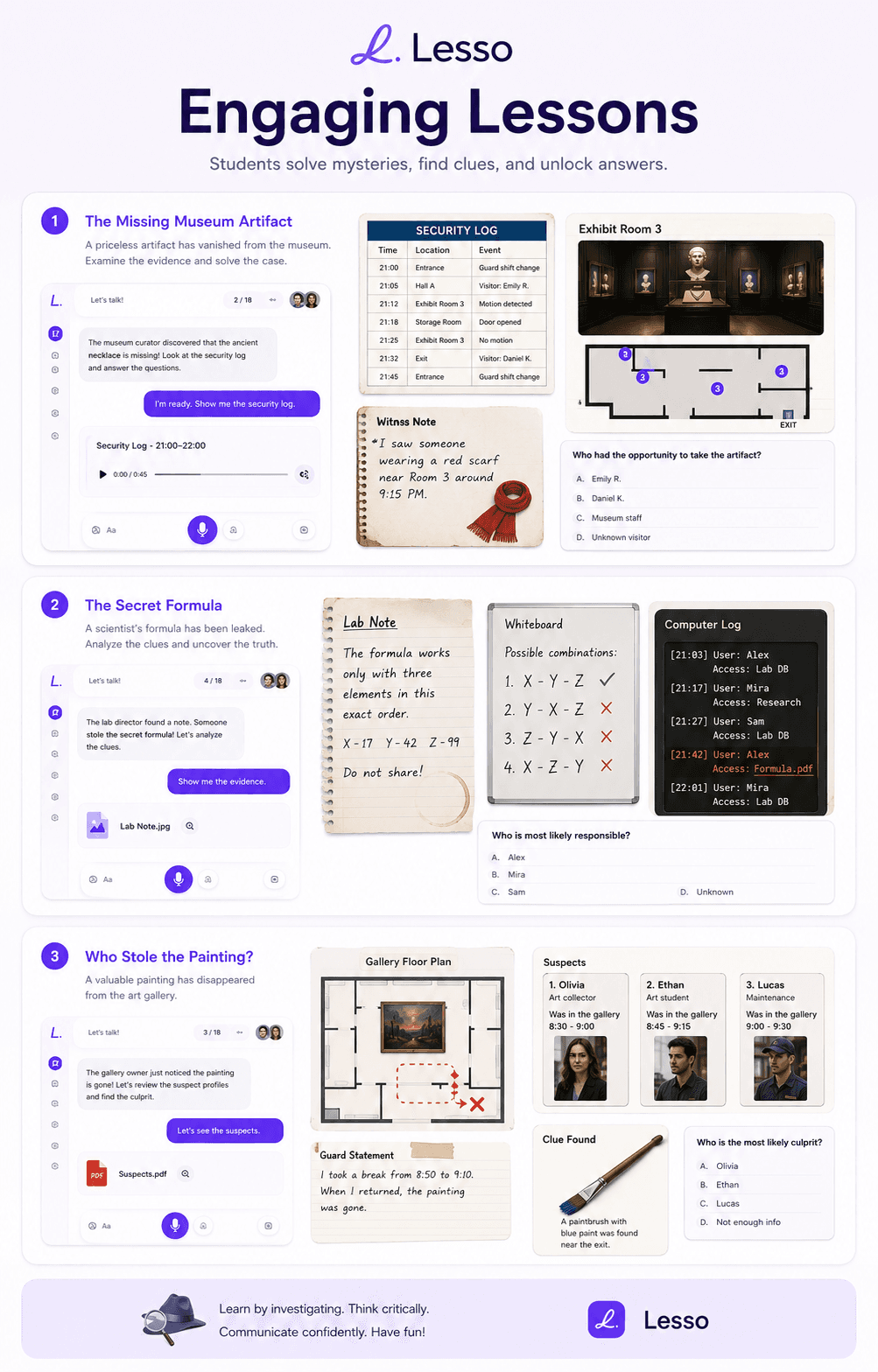
17. Detective alibi interview — Mystery format: AI is a detective; student is a witness who saw something suspicious near a museum. Prompt example: “Role-play: Student = witness who saw a person in a red scarf near the museum at 9:15 p.m. AI = detective interviewing carefully. Level B1. Ask where student was, what they saw, what they are sure vs unsure about. Student must use past continuous and past simple. Do not reveal culprit—only gather testimony.”
18. Podcast guest: passion project — Student explains a hobby (gaming, cooking, sport) to an enthusiastic host who asks follow-ups. Low anxiety, high fluency. Prompt example: “Topic-based: AI = podcast host recording episode ‘Hidden Talents.’ Student = guest explaining their hobby (student chooses). Level B1+. Ask why they started, funniest moment, what they would teach a beginner. React with short encouragements. Student should speak at least three long turns.”
19. Apologizing to a friend — Student was late and forgot a birthday; AI friend is hurt but willing to listen. Emotional intelligence plus functional apologies. Prompt example: “Role-play: Student = friend who missed Sam’s birthday dinner and did not text. AI = Sam, disappointed but not cruel. Level B1. Student must apologize sincerely, explain without excuses, suggest making it up. AI softens if apology is genuine; stays cool if student minimizes.”
20. Survival scenario: power outage weekend — Student and AI are roommates planning how to cook, charge phones, and stay warm during a 48-hour outage. Creative problem-solving with modals. Prompt example: “Role-play: Student and AI = roommates in apartment during winter power outage. No elevator, fridge warming. Level B2. Each turn propose one practical idea (we could…, we should…, if we…). Disagree once, then compromise. End with a shared plan for dinner tonight.”
Prompt patterns that work every time
Strong prompts name four things: roles (who is who), situation (one concrete problem), language level, and success criteria (what the student must accomplish before the scene ends). Weak prompts say only “practice speaking about travel” and the AI drifts into a lecture.
Add a stay-in-character line: “Do not mention English practice, lessons, or AI.” That single sentence stops the partner from breaking the fourth wall with “Great job practicing!” every thirty seconds.
Tell the AI how hard to push. For shy A2 classes: “Keep your turns under one sentence; be patient.” For B2 debate: “Politely disagree at least once.” For interview prep: “Ask ‘Can you give an example?’ if answers are vague.”
Recast instruction belongs in the prompt when you care about form: “When the student makes a tense error, repeat the correct form naturally in your reply and continue.” That is gentler than interrupting with grammar rules.
Time-box in the prompt for classroom rhythm: “Wrap the scene in about 8 exchanges and end with a natural goodbye.” Students on Pro plans may have longer Talk sessions; in-lesson AI conversation blocks often run five to ten minutes per student.
Matching activities to CEFR levels
A2 learners do best with clear roles, one problem, and predictable vocabulary—café, directions, neighbor favor, pharmacy. Avoid negotiation and abstract debate. Keep AI turns short.
B1 is the sweet spot for most items here: hotel, travel delay, job interview basics, detective interview, apologies. Students can handle sequences (first… then…) and polite disagreement.
B2 and above: returns and policy calls, rental dispute, chart explanation, debate, salary talk. Add challenge modes in Lesso Talk (No hints, Debate, Immersion) when students need stretch tasks.
If your class is mixed level, duplicate the lesson, paste the same scenario with different support—simpler menu for A2, bonus negotiation beat for B2—and assign links by group. Lesso monitoring still shows who is on which lesson.
After speaking: make it count
Speaking without feedback fades fast. In class, ask pairs to share one useful phrase the AI used. For homework, require students to paste one line from the Talk transcript they want to improve and rewrite it.
On Plus and Pro, students see session summaries and weak-point hints in Lesso Talk—point them to one improvement tip before the next lesson. Teachers on Pro can assign speaking homework generated from a Talk session so follow-up becomes a short lesson block.
Pair AI speaking with a preceding vocabulary or listening block in the same lesson so the conversation is not cold start. The twenty activities above all assume students have met the topic once in another block—or you spend five minutes pre-teaching key phrases on the board.
Try three this month
Week one: pick an everyday life scenario at your class level (activities 1–5). Add an AI conversation block to an existing lesson, paste the prompt, preview as a student, publish.
Week two: run one travel scenario live with headphones in class while others do a writing task—then rotate.
Week three: assign one work or opinion activity (11–20) as Lesso Talk homework; start the next lesson with two volunteers summarizing what happened in their scene.
If you are new to AI conversation blocks, read What is Lesso.me? for publishing and monitoring basics, then our super-engaging lesson formats post if you want the same scenarios wrapped in a mission narrative. Speaking should feel like something students would do anyway—AI just gives everyone a partner who always has time.