2026-06-27 · 11 min read
Super-engaging lesson formats: turn any topic into a detective mystery, escape room, or space mission
Lesso can now build a whole lesson as a game-style mission. Pick a format—detective mystery, escape room, treasure hunt, courtroom trial, survival adventure, spy mission, time-travel, or space mission—type your topic, and AI writes the entire scenario into your lesson. Students learn by doing and win by using the language.
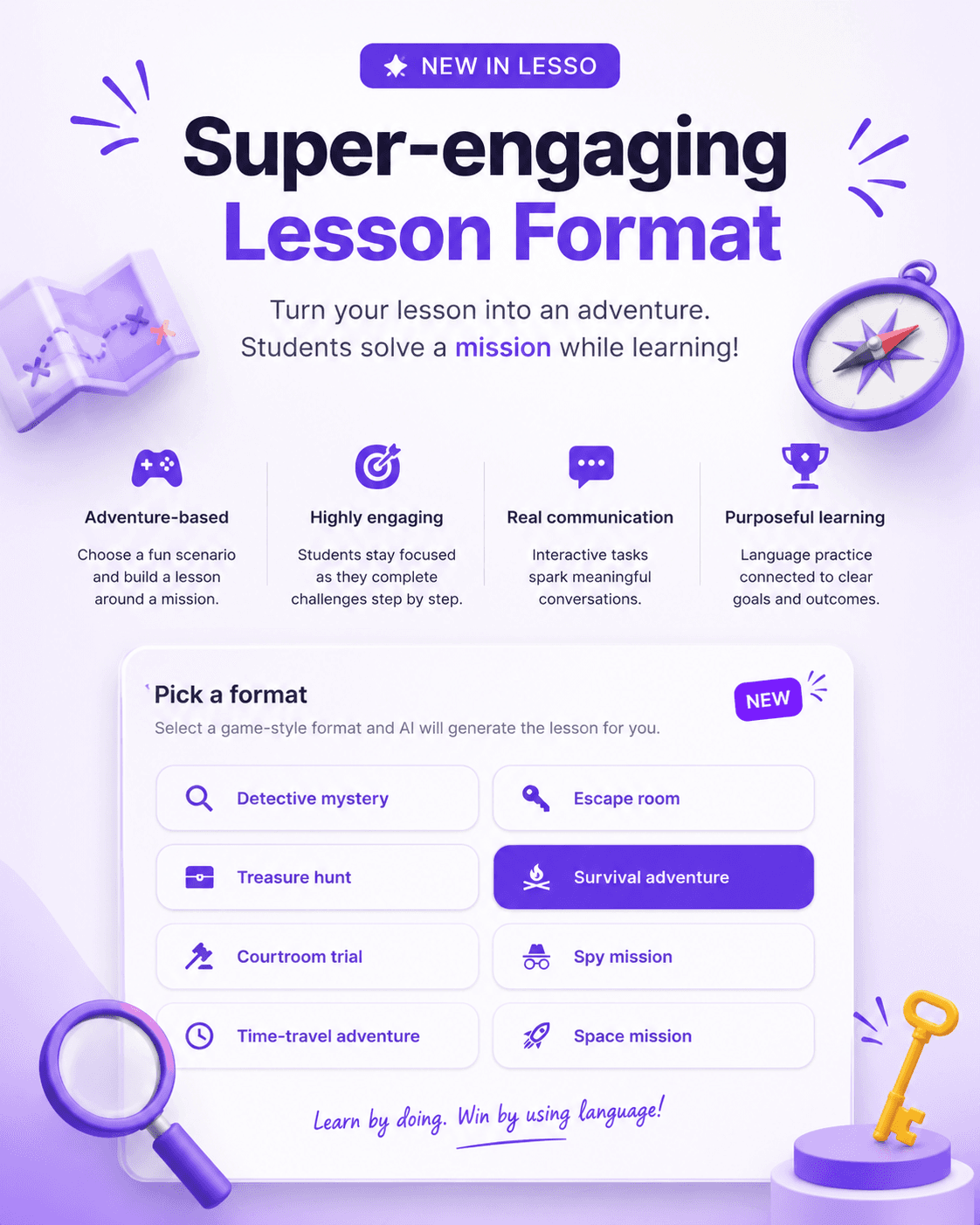
Learn by doing. Win by using language.
Students remember the lesson where they cracked a case, escaped a locked room, or landed a spacecraft far longer than the lesson where they answered ten questions about a paragraph. Today we are launching super-engaging lesson formats: a one-click way to turn any topic into a game-style mission that students solve while they practice the language.
Instead of describing a lesson from a blank page, you pick a format—Detective mystery, Escape room, Treasure hunt, Courtroom trial, Survival adventure, Spy mission, Time-travel adventure, or Space mission—and AI writes the entire scenario into your lesson description for you. From there it generates the full lesson the way it always has: structured blocks you can review, edit, and publish on the same student link.
The idea behind it is simple, and it is printed right on the launch graphic: learn by doing, win by using language. A format gives students a reason to read the clue, listen to the witness, and say the sentence—because they need it to move forward in the story.
Where to find super-engaging formats
Open Create a new lesson in your teacher workspace. In step one, Describe your lesson, you already have Suggest random topic and Build lesson manually. Just below them you will now see a bordered section titled “Or start from a super-engaging format.”
Inside it are eight format buttons—Detective mystery, Escape room, Treasure hunt, Courtroom trial, Survival adventure, Spy mission, Time-travel adventure, and Space mission—each with its own icon. The hint under the heading says it directly: pick a game-style format and AI writes the whole scenario into the description below.
There is one small but important habit: type a topic first. The “What would you like to teach?” box is still there, and the format is built around whatever you put in it. Add “past simple, A2 teens, daily routines” and choose Detective mystery, and you get a whodunit that practices past simple at A2—not a generic mystery disconnected from your syllabus.
How it works, step by step
Type your topic, level, and any focus in the description box (a sentence or two is enough). Then click a format. Lesso writes a complete scenario—setup, characters, clues, and a goal—straight into the description, so you can read and tweak it before generating anything.
If you already have a description or a generated structure, Lesso asks first: “Replace your current lesson?” Choose “Yes, write scenario” to let the format take over, or “Keep what I have” to back out—your existing work is never overwritten by accident.
Once the scenario is in place, you generate the lesson exactly as usual. AI fills the blocks—reading, vocabulary, listening, tasks, speaking—around the mission, in your target and support languages. You review every block, regenerate any single one that needs work, and publish the same shareable link your students already use.
Nothing about sharing, live monitoring, or completion changes. The format simply gives the AI a strong, engaging spine to hang the lesson on, so the activities feel like steps in a story rather than a list of exercises.
The eight formats
Detective mystery — a case to crack. Students examine evidence, read witness notes, listen to statements, and narrow down suspects to answer “who did it?” Excellent for past tenses, question forms, and describing people and places.
Escape room — a locked scenario with combinations to find. Students gather clues across steps and piece them together to “unlock” the answer. Great for sequencing, instructions, numbers, and careful reading.
Treasure hunt — follow clues from place to place toward a final reward. Strong for prepositions of place, directions, imperatives, and vocabulary tied to a theme.
Courtroom trial — evidence, testimony, and a verdict. Students weigh arguments and justify a decision, which pushes opinion language, modals of deduction, and persuasive speaking.
Survival adventure — make decisions to stay safe and reach the goal. Ideal for first conditional, advice and warnings, and problem-solving conversation.
Spy mission — decode messages and complete objectives without being caught. Fun for reported speech, instructions, and reading between the lines.
Time-travel adventure — jump between eras and fix the timeline. A natural fit for tenses across past, present, and future, and for cultural and historical topics.
Space mission — a crew, a problem, and a planet to reach. Works well for sequencing, technical vocabulary, and collaborative decision-making.
Why mission-based lessons work
The launch graphic frames the benefit in four words that match how good language teaching actually runs: adventure-based, highly engaging, real communication, purposeful learning.
Adventure-based means students choose a fun scenario and build a lesson around a mission, so the topic has a shape and a destination instead of being a loose collection of exercises. Highly engaging means learners stay focused because they are completing challenges step by step—each block moves the story forward.
Real communication is the part that matters most for a language class: interactive tasks spark meaningful conversation, because students have a reason to ask, explain, agree, and disagree. And purposeful learning keeps it honest—the language practice is connected to clear goals and outcomes you set when you typed your topic, not to the theme for its own sake.
In other words, the story is the carrier; the language is the cargo. Students push to solve the case, and the target grammar and vocabulary are exactly what they need to do it.
A worked example: The Missing Museum Artifact
Picture a Detective mystery built around “past simple and time expressions, B1.” The setup: a priceless artifact has vanished from a museum, and students must examine the evidence and solve the case.
Across the lesson, AI can lay out a security log with times and locations, a witness note (“I saw someone wearing a red scarf near Room 3 around 9:15 PM”), a floor plan of the exhibit rooms, and a short audio briefing from the curator. The final task asks the real question: who had the opportunity to take the artifact?
To answer, students read the log, decode the times, listen to the statement, and rule suspects in or out—using past simple, prepositions of time, and the language of deduction the whole way. That is the same content you would teach anyway, delivered as a case students actually want to close. The infographic for this launch shows three of these built end to end: a missing artifact, a leaked secret formula, and a stolen painting.
Pair formats with interactive blocks
Formats are even stronger when the mission lands on interactive task blocks rather than plain reading. After generating, consider where each new block fits the story: a listening block becomes the witness statement, spot the mistake becomes a “forged document” to correct, word ordering becomes a scrambled coded message, and flashcards become the case file vocabulary.
A speaking task or AI conversation (on Pro) makes a natural finale: the student interrogates a suspect, negotiates with mission control, or presents their verdict. Because the scenario already gives roles and stakes, the speaking prompt practically writes itself.
You do not have to use every block type. One well-placed task per beat of the story keeps momentum; a mystery with a security-log reading, one comprehension check, and a final “name the suspect” task is tighter than ten exercises stacked together.
Tips for great results on the first try
Type the topic and the language goal before you click a format: not just “space,” but “space mission, first conditional, B1 teens.” The format wraps around your goal, so the more specific you are, the more on-syllabus the scenario.
Read the scenario it writes into the description and trim or steer it before generating—shorten the setup, name the characters, or set the era for time-travel. A few edits here shape the whole lesson.
After generation, open lesson view and read it as a student. If one block drifts from the story, regenerate just that block with an instruction like “tie this to the museum case, keep it B1.”
Match the format to the grammar you want: detective and time-travel for tenses, escape room and treasure hunt for instructions and prepositions, courtroom and survival for modals and opinion language. The right pairing makes the practice feel inevitable, not bolted on.
Try it this week
Pick one class you teach this week and a topic you would normally cover with a reading and a quiz. Open Create a new lesson, type the topic and level, and choose a format that fits your grammar aim.
Read the scenario AI writes, generate the lesson, and preview it as a student. Publish the same link you always share, then watch live monitoring as students work through the mission step by step.
If you are new to building with blocks, pair this with our posts on the four interactive practice blocks and how to use lesson blocks effectively—then let a detective mystery or space mission carry your next topic. Learn by doing; win by using language.